How many elementary particles are there, really?
I read this great Quanta piece and the part that stuck with me is that the question has no single answer. So I made a thing.
It is a scrolling census of the Standard Model where the particle count grows depending on how strictly you count. You can open it here: The Standard Model census.
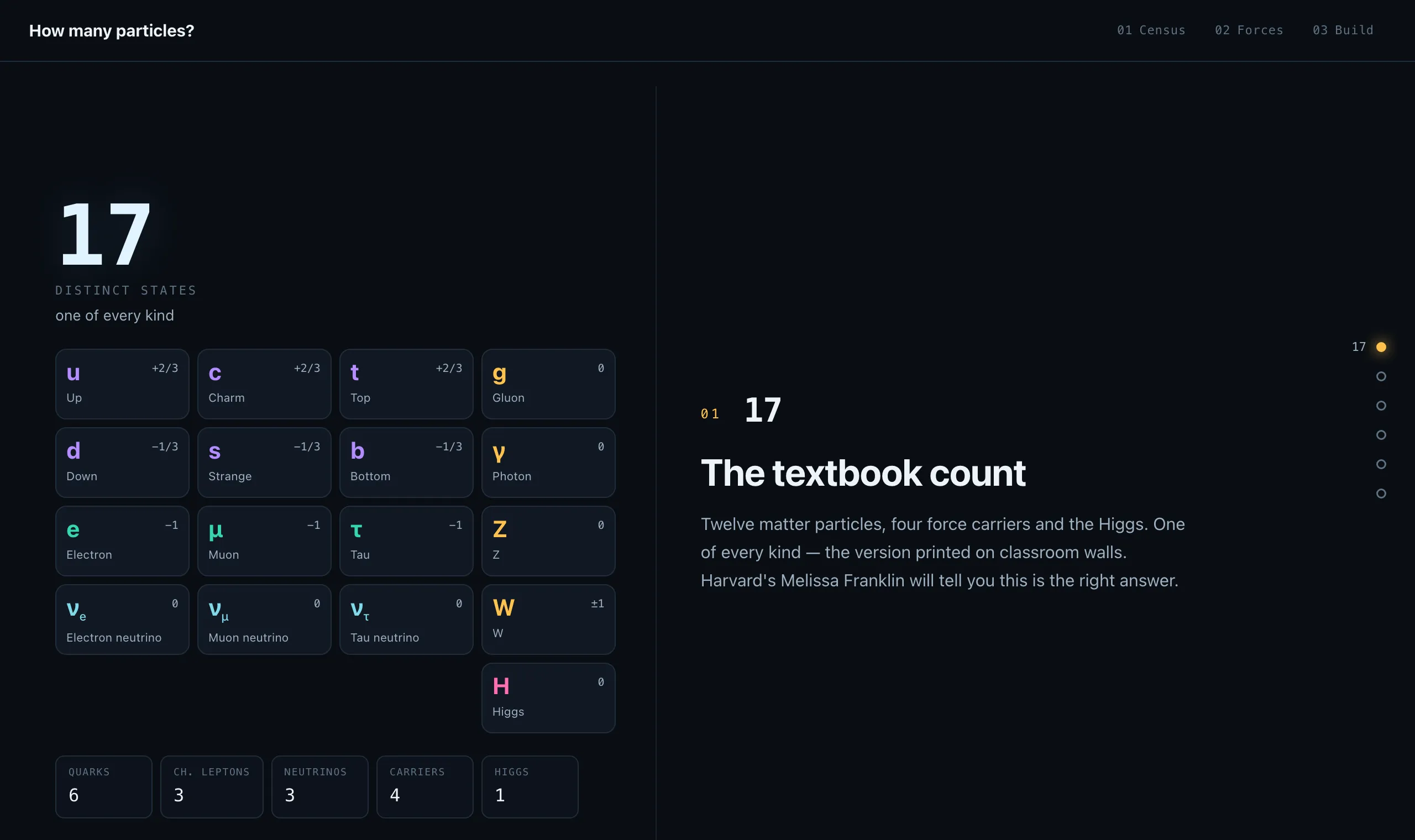
You start at 17, the textbook poster of twelve matter particles, four force carriers and the Higgs. Then you scroll and the number climbs. Add the antiparticles and you get 30. The one gluon is really eight, which takes you to 37. Every quark comes in three colours, so 61. Split the fermions into left and right chiralities and give the bosons their polarizations and you reach 118, where the lopsided total comes from neutrinos only ever showing up left-handed. Keep going and you stop counting particles and start counting the underlying quantum fields, which lands on 995.5 degrees of freedom from a 2011 theorem. The same equations give very different answers.
There is also a four-forces matrix with gravity’s missing graviton, a “build a hadron” tool that only lets you assemble colour-neutral combinations, and a clickable dossier for every particle with its mass, lifetime, discovery and decay channel. The numbers follow Particle Data Group 2024 central values. No tracking, no network calls, and it runs offline once you save the file.
Enjoy!
// comments